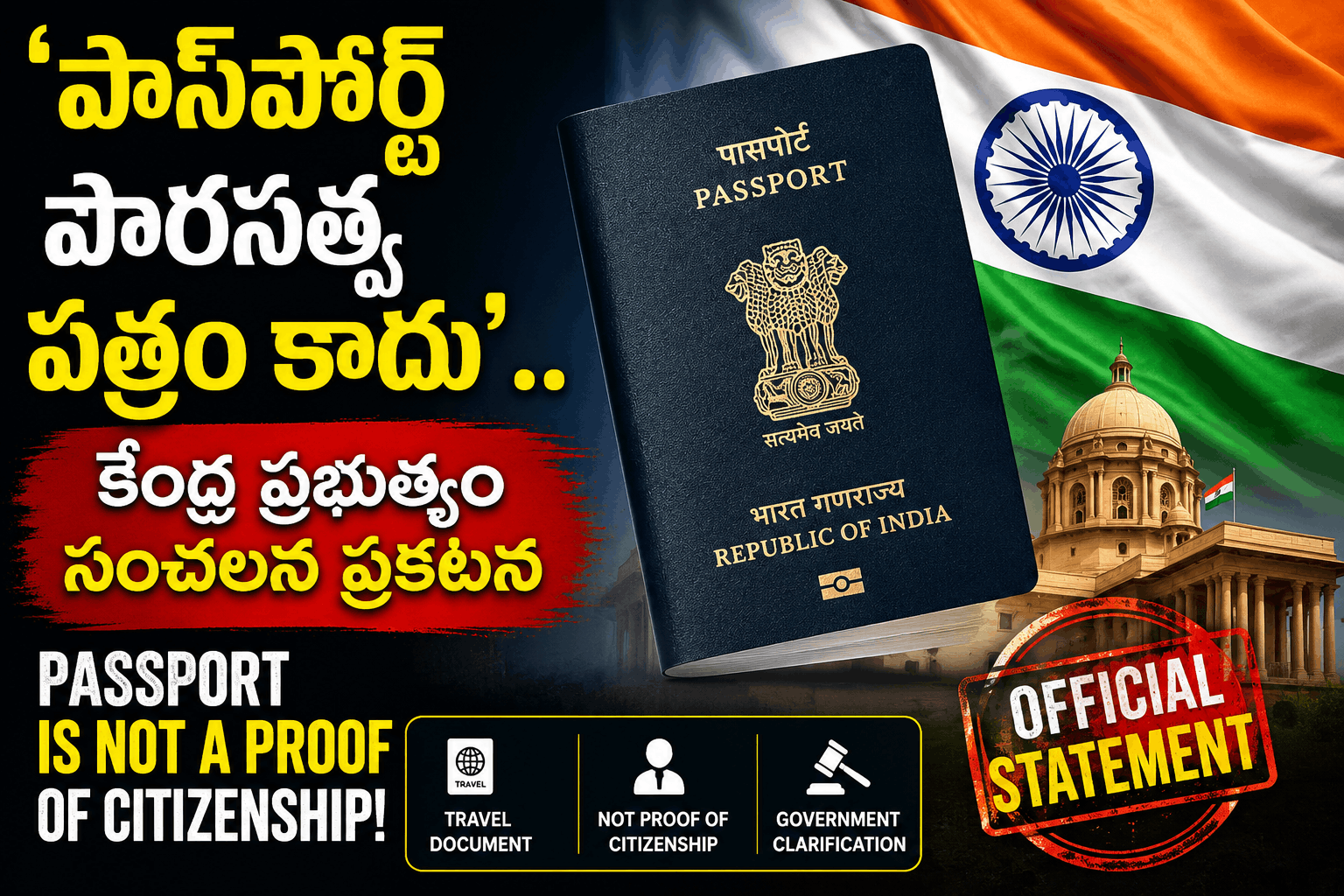
The Ministry of External Affairs (MEA) has issued an important clarification regarding the Indian Passport, stating that a passport is primarily a travel document issued by the Government of India and should not be considered conclusive proof of Indian citizenship.
The announcement was made during the 14th Passport Seva Divas, sparking widespread discussions on social media and raising questions about what actually constitutes proof of Indian citizenship.
Why Is This Clarification Making Headlines?
Millions of Indians consider the passport one of the most powerful government-issued documents. However, the Ministry clarified that:
- An Indian Passport is issued to facilitate international travel.
- It confirms that the holder has been issued a passport by the Government of India.
- It is not a definitive legal document proving citizenship in every situation.
This clarification has led many people to ask:
If a passport is not proof of citizenship, then what is?
What Is an Indian Passport?
An Indian Passport is an official Travel Document issued by the Government of India that allows citizens to travel internationally.
It helps with:
- International travel
- Visa applications
- Immigration clearance
- Identification abroad
However, the government has clarified that its primary purpose is travel, not serving as the ultimate proof of citizenship.
Your Passport Is Government Property
Many people are unaware that an Indian Passport is not the personal property of the holder.
The back page of every passport clearly states:
“This Passport remains the property of the Government of India.”
This means the government has the authority to revoke or require the return of the passport whenever necessary under applicable laws.
Is Aadhaar Proof of Citizenship?
No.
The Aadhaar card is:
- An Identity Document
- An Address Proof
However, it does not establish Indian citizenship.
The Supreme Court has also clarified that Aadhaar is meant only for identity verification and access to government services.
Is Voter ID Proof of Citizenship?
The Voter ID Card is mainly used for:
- Voting in elections
- Identity verification
- Address verification
While it indicates eligibility to vote, it is generally not treated as a standalone conclusive proof of citizenship in every legal context.
Who Gets Indian Citizenship?
The Citizenship Act provides different rules depending on the date of birth.
People Born Between January 26, 1950 and July 1, 1987
Anyone born in India during this period is generally considered an Indian citizen by birth.
People Born After July 1, 1987
At least one parent must be an Indian citizen at the time of birth.
People Born On or After December 3, 2004
Citizenship by birth is granted if:
- Both parents are Indian citizens,
OR
- One parent is an Indian citizen, and
- The other parent is not an illegal migrant.
What Is the Actual Proof of Indian Citizenship?
India does not have a single universally accepted document that serves as absolute proof of citizenship in every circumstance.
Depending on the legal requirement, authorities may examine:
- Birth Certificate
- Parents’ citizenship records
- Government records
- Citizenship certificates (where applicable)
- Other supporting legal documents
Each case is evaluated according to the provisions of the Citizenship Act, 1955, and related rules.
Major Improvements in Passport Services
The Ministry of External Affairs also shared several achievements in passport services.
Key Highlights
- 1.5 crore passport-related services delivered in 2025.
- 1.39 crore new passports issued.
- Passport delivery within 6 working days (excluding police verification).
- Nationwide rollout of Chip-based e-Passports.
- Passport service centers increased from 77 to 545.
- Average waiting time at Passport Seva Kendras reduced to less than 45 minutes.
What Is an e-Passport?
The new e-Passport contains an embedded electronic chip that securely stores the passport holder’s information.
Benefits include:
- Better security
- Protection against forgery
- Faster immigration processing
- International ICAO compliance
- Improved traveler convenience
Important Facts Every Citizen Should Know
✔ A Passport is primarily a Travel Document.
✔ It is not conclusive proof of citizenship.
✔ Aadhaar is an Identity Document, not citizenship proof.
✔ Voter ID mainly establishes voting eligibility and identity.
✔ Citizenship is determined under the Citizenship Act, 1955, based on legal criteria.
✔ Indian Passports remain the property of the Government of India.
Frequently Asked Questions (FAQs)
Is an Indian Passport proof of citizenship?
No. The Ministry of External Affairs has clarified that a passport is mainly a travel document and is not, by itself, conclusive proof of citizenship.
Is Aadhaar proof of Indian citizenship?
No. Aadhaar is only an identity and address verification document.
Is a Voter ID proof of citizenship?
A Voter ID allows eligible citizens to vote and serves as identification, but it is not universally treated as standalone proof of citizenship.
How long does it take to get an Indian Passport?
Currently, passports are generally delivered within 6 working days, excluding the time required for police verification.
Conclusion
The Government of India’s latest clarification has helped clear a common misconception. While an Indian Passport is one of the country’s most important official documents, its primary purpose is to facilitate international travel and it should not be regarded as the sole or definitive proof of Indian citizenship. Likewise, Aadhaar and Voter ID cards also serve different legal purposes. Citizenship in India is determined under the Citizenship Act, 1955, based on applicable laws and supporting records. Citizens should rely on official government guidelines and avoid misinformation circulating on social media.